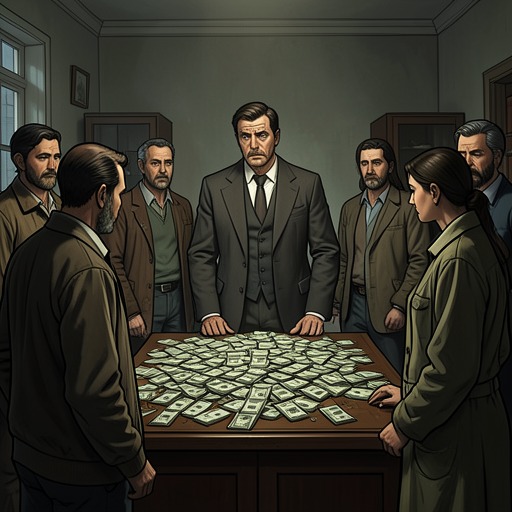
Argentine currency controls (cepo cambiario)
La uruguayaArgentine currency controls (cepo cambiario) shape Lucas Pereyra’s trip to Montevideo by making the location and form of payment matter as much as the amount earned. With transfers to Argentina converted at the official rate and reduced further by income tax, he sought his $15,000 in Uruguay, intending to return with cash and exchange it on Argentina’s parallel market. The controls turn an author’s payment into a border-crossing calculation: a way to reclaim working time, but one shadowed by limits, scrutiny, and uncertainty.
How the Controls Reshape Payment
Pereyra had opened a bank account in Montevideo in April, but the advances from Spain and Colombia did not arrive until September, months after he had signed the book contracts. If the dollars were transferred to Argentina, the bank would convert them at the official exchange rate and deduct income tax. By collecting the money in Uruguay and bringing back banknotes, he expected to exchange them in Buenos Aires at the unofficial rate and retain more than twice as much. The account and the journey were therefore not incidental logistics: they were a response to the gap between the official valuation imposed on a transfer and the value available through the parallel market.
The sum was $15,000: $8,000 from Spain and $7,000 from Colombia. Pereyra compared the parallel-market value, about 240,000 pesos at the time, with the less than half that he expected to receive through a national bank. His calculation belonged to a period when the peso was devaluing, prices were rising, and several competing dollar values circulated. The proliferation of official, parallel, and other named rates made the value of ordinary transactions difficult to judge; the controls did not simply restrict access to foreign currency, but divided its price into competing measures.
Crossing the Border with Cash
To benefit from that difference, Pereyra planned to bring back more dollars than the permitted amount. He recognized the possibility that customs officers might find the money on his return, making the trip a calculated risk rather than a routine withdrawal. At the port in Montevideo, an employee’s unusually prolonged look at him and the questioning that accompanied his ticket sharpened his suspicion that same-day travelers might be watched or listed. The scene does not establish that anyone was monitoring him, but it gives the border a personal atmosphere of inspection before he has even reached the bank.
On the return to Buenos Aires, customs staff stopped and searched him. They patted him down, checked his jacket, asked him to lift his shirt, and looked inside the ukulele he was carrying. The search was directed at concealed bundles of cash, but by then he had no money on him: it had been taken in the assault on the beach. He was allowed through. His experience exposes the physical side of a system otherwise described through exchange rates and electronic transfers: the planned financial workaround depended on carrying paper money through a checkpoint, where the body and its belongings became objects of inspection.
Money, Debt, and the Time to Write
For Pereyra, the advances were not an abstract gain from exchange-rate arbitrage. He imagined using them to repay his wife, cover overdue bills, make repairs at home, return money to his brother, and hire a nanny so that he could work without interruption. He hoped the funds would buy nine or ten months of concentrated writing time. The books behind the payment were concrete obligations: a collection of chronicles for Milenio and a novel for Astillero, both due in May. The money’s value lay partly in the labor it represented and partly in the uninterrupted time he hoped it could secure.
The trip also answers a household crisis that had accumulated through unpaid expenses and deferred repairs. Pereyra connects his lack of money with a wider paralysis: projects left unfinished, work not pursued, and everyday problems postponed. He had imagined the dollars as a means of clearing that fog and restarting his work. Yet the cash never becomes the household rescue he planned. After the assault, he returns to Argentina without it, and understands that he must go back to Buenos Aires. The loss makes visible how much of the journey’s promise depended on a sum that could be valued differently, moved across a border, and then suddenly disappear.
The Controls as a Narrative Boundary
The crossing from Argentina to Uruguay gives the currency controls a spatial form. Pereyra leaves the country to reach money that his work has earned, experiences the journey as temporary relief from his ordinary confinement, and faces inspection when he returns. The open water and the movement between ports suggest escape, while the cash plan remains bound to exchange rules, customs limits, and the risk of being searched. His freedom is therefore practical but provisional: the border offers a route around the official conversion, not an escape from the system that makes the route necessary.
The controls also connect economic policy to the novel’s question of what money can make possible. The anticipated dollars stand at once for debt repayment, domestic repairs, and the ability to write; they promise a future in which work can continue without immediate financial interruption. Their disappearance does not erase those needs. Instead, it exposes the precariousness of treating money as time secured in advance: the exchange calculation can be exact, while the life it is meant to stabilize remains vulnerable to events beyond the calculation.